Showing posts with label articles. Show all posts

Wednesday, November 29, 2006

Make Biodiesel out of Used Cooking Oil

I had been very lazy to blog about food lately, and I have not even started packing for my trip to Canada!

But last night, I somehow got into reading about biofuel and biodiesel.

We all have heard about global warming...many of us want to contribute to delaying if not preventing its catastrophic effects.

I read about how the Philippines has been making biodiesel and how it targets to be a major supplier to developed countries...As usual and as I expected, there is a huge manufacturing company involved, making use of coconut oil. Of course, this does minimal to help alleviate poverty, and while it provides job opportunities for coconut farmers, it does not address the potential of recycling used cooking oil and EMPOWERING the ordinary people. I read in a forum about some Filipinos already homebrewing it, but the latest was 2004. Was there a move by the government to suppress household production of biodiesel?

I PLAN TO SOMEDAY MAKE BIODIESEL out of used cooking oil collected from nearby restaurants (if I can get them for free). But, thinking of how ubiquitous carinderias, eateries, and small restaurants in the Philippines are, I could not help but post about it here. For a start, it will be a very good science project for high school students, not only because of the issue of recycling, but also looking into the issues of alternative fuels and less carbon emission into the environment to lessen global warming, use of resources naturally abundant in the Philippines, and empowering even the common household in my beloved country in that they, too, can lessen their need for fossil fuels and can even start generating income from this (if government allows).

Why I want the high school science project as a starting point -- the high school students usually have the right chemistry background and guidance; they can easily request to "haul away for free" the waste cooking oil used by restaurants (who would be glad to get rid of the "waste" without having to pay for disposal, and who would shy away from charging the students a fee); and they can easily generate funds through solicitation letters for other materials/equipment they would need to make the project.

The diagram for the process is shown here. The biodieselcommunity.org provides a very comprehensive resource for those who want to make it on a small scale (as small as a liter) or on a larger scale.

The small batch making is simple enough to be carried out using ordinary materials (and that's how I plan to start). Families who wish to make it on a larger scale (but still small compared to the big oil manufacturers) might find use of the diagram of the "Appleseed Processor found here (needs some engineering/plumbing know-how - I am expecting that a lot of scientifically-inclined Filipino HS students will find this interesting). Negotiating for Waste Vegetable Oil (WVO) is a very interesting read for gathering the most important raw material, but this will be needed only if families start making their own biodiesel out of WVO from nearby restaurants.

For the common household who want to experiment first to come up with one liter of biodiesel, here is a recipe, from the "World Famous Dr. Pepper Technique." (Dr. Pepper is the soda brand of the bottle they used in this process.)

World Famous DR Pepper Technique (Pat Pend)
The idea for the Dr Pepper Technique came about one day many years ago (it seems) when I was trying to figure out an inexpensive way of making my first few test batches of biodiesel.

I will assume that if you are reading this for the information then you are new to Biodiesel making, so just a few words of caution:

THESE ARE DANGEROUS/POISONOUS CHEMICALS.
COMMON SENSE MUST BE USED.
YOU ARE RESPONSIBLE FOR YOUR ACTIONS AND THE SAFETY OF YOURSELF AND EVERYONE/EVERYTHING AROUND YOU.


METHANOL IS A POISON WHICH CAN BE ABSORBED THROUGH YOUR SKIN, BY INHILATION, OR CONSUMPTION.
METHANOL CAN CAUSE BLINDNESS AND DEATH.
METHANOL IS AS FLAMMABLE AS GASOLINE/PETROL.
CARTRIDGE RESPIRATORS DO NOT WORK WITH METHANOL.

SODIUM HYDROXIDE (Caustic soda, NaOH, lye) can cause severe burns and death. wash off with water.

Long-sleve shirt, full shoes and trousers are recommended, no shorts or sandals.
Wear chemical proof gloves, apron, and eye protection.
Always have running water available to wash off any splashes.
DO NOT INHALE ANY VAPOURS!.


Now that I have managed to scare you, just realize that Methanol is the fuel used in most Model airplanes. In the USA methanol is available in small quantities as HEET brand fuel line antifreeze (Yellow bottle)
Lye is an every-day drain cleaner.
Both are freely available in most large shopping centres.


MATERIALS REQUIRED
1 litre oil- new or used
NaOH (lye/ caustic soda), at least 6g. Used as a drain cleaner and can often be found next to the Drano.
Methanol at least 250ml. HEET® Gas- Line Antifreeze in the yellow bottle is methanol and readly available in most auto supply stores in the USA.

EQUIPMENT REQUIRED
1- 2 litre (1.9 in US) Dr Pepper Bottle in sound condition with tight fitting top and dry inside.

1-measuring cup to measure out 250ml methanol
1-scales to measure 6- 7g NaOH
OR
1 teaspoon measure metric or imperial.

1- container to mix the methanol and NaOH in which makes methoxide.

1- Funnel

THE TECHNIQUE:

OIL PREPERATION

If using waste oil, take one litre and heat to at least 120 deg c to remove all water. If water is present the oil will spit and pop and carry on. If there is a lot of water this could get very violent, so be careful.
Once the water is gone (Oil becomes calm and there is no more spitting and popping) let the oil cool.

If you are using new oil from the bottle it should have no water in it, so in this case just heat to 55deg c when you are ready to mix.

MAKING THE METHOXIDE
WARNING: METHOXIDE IS A POISON!
DO NOT BREATH VAPORS.
WASH OFF ANY SPLASHES.
DO NOT MIX THE METHOXIDE IN A PLASTIC SOFT DRINK BOTTLE AS THE NaOH ATTACKS THE PLASTIC AND YOU WILL QUICKLY BE SHAKING A BOTTLE FULL OF HOLES WITH METHOXIDE GOING EVERYWHERE.

While the oil is cooling mix your methanol and NaOH(lye) to form the methoxide.
Use 250ml of methanol. This is more methanol than most people use but will help insure a successful first batch.
If you are using new oil this will require 5g (about half a Teaspoon) NaOH.
For used oil, you should do a titration to determine the correct amount of NaOH to use.
However, if you do not have the materials to do a titration, just use the imperical quantity of about 7g NaOH as this amount almost always achieves seperation. If you do not have a scales, this is about 1 level teaspoon measure (metric or imperial).

NaOH and Methanol do not readily mix, so if you are doing it by hand a bit of time and patience is required. Don't sniff the fumes. CARTRIDGE RESPIRATORS DO NOT WORK WITH METHANOL
For quickest mixing, start with the methanol at JUST body temp (not warm). As you mix, the temp will increase substantially. This is normal. Make sure ALL the NaOH (lye) is disolved. This may take 10 minutes or more.
Hand mixing can be accomplished using the back of a spoon to stir/crush the NaOH granules ina coffee cup or glass; OR placing methanol/NaOH in a glass bottle with a tight fitting top and shaking/ swirling until ALL NaOH is disolved.
After ALL the NaOH has disolved, top up to 250ml with fresh methanol, as there may be some evaporation during mixing.

MAKING THE BIODIESEL!
When the Oil's temp has dropped to 60 deg c or a bit less, using a funnel, pour the litre of oil into a DRY 2 litre Dr Pepper bottle (in a pinch any other brand of bottle will do).
Take the mixture of methanol/NaOH (commonly called methoxide on this forum) and pour on top of the oil using the same funnel.
Remove funnel.
Screw the top down TIGHT onto the bottle.
Shake vigerously for about ten seconds/ 40 good shakes.
NO appreciable pressure is generated during this mixing.

Now place the bottle on a table.
If you were using WVO you will probably observe the oil change colour from a "Light Chocolate milk to a rich, darker brown."
Then, as if by magic, within 10 minutes the by-product (commonly refered to as glycerine on this forum) starts to settle out and form an increasing layer on the bottom of the bottle.
Be sure to notice that you can see a very definate, slowly sinking line towards the top of the Biodiesel as the glycerine slowly settles.
Within an hour, most of the glycerine will be settled out.
This is referred to as seperation.
NOTE: Neutral has shown through GC tests that although one 10 second shake produces very useable Biodiesel it is in fact not ASTM conversion standard.
To produce ASTM conversion biodiesel requires titration and a further four- 5 second shakes over the space of an hour.


If you used New Oil, the colour change is not nearly as great and you may have problems seeing much of a colour change at all.

You should now have a bottle containing lighter coloured biodiesel on top of a layer of darker glycerine.
If you reacted New Oil the glycerine layer on the bottom will not be much darker than the oil you started with and the biodiesel will usually be very light in colour.
The biodiesel will be very cloudy, and it will take a day or two more for it to clear.

If it does not work out come onto the forum and see if anyone can figure out what went wrong.

And that is all there is to it. Only a little magic is involved.

Remember, after producing in excess of 53,459 litres of biodiesel in any calander year using this process, please make royality check out to Tilly From Paradise and send it to me through your favourite Numbered Swiss bank account.

CARTRIDGE RESPIRATORS DO NOT WORK WITH METHANOL

A few cautions: DON'T mix the methanol and NaOH (lye) in a plastic bottle as NaOH attacks some types of plastic. Once mixed it is quite acceptable to mix your biodiesel in a Dr Pepper plastic bottle.
Do NOT store unused methoxide in plastic bottles. Some plastic will degrade over time when in contact with methoxide.

DO NOT allow any WATER into any steps of this procedure.

Methanol boils at about 65 deg c. DO NOT mix until the oil is below 60 deg c.

Again, these are dangerous chemicals and care is necessary, especially if there are children in your home.

YOU ARE RESPONSIBLE FOR YOUR ACTIONS AND YOUR SAFETY AND THE SAFETY OF EVERYONE AROUND YOU.

I have Up-Sized the Dr Pepper technique by using a 20 litre plastic drum (longish and skinny) and make 14 litre batches. I simply lay the drum on a wooden "cradle" and place the center of the cradle on a pipe and rock back and forth for 3 or 4 minutes.
I then decant the mixture into a "finishing" container and so am ready to process another 14 litres straight away.


Now that you have a Litre of Finest biodiesel you will probably wish to wash it and this is quite easily accomplished using the World Famous Dr Pepper Wash Technique (Pat Pend).


So now that is added to my list of "Want-To-Do" in the future. I will start with producing a liter, then, if I manage to convince my husband to build me the Appleseed Processor, move on to a higher scale of production, at least for personal consumption, mainly heating our house during winter.

And yes, I am a wannabe homesteader, who wants to take part in the "Sustainable Living" and "Voluntary Simplicity" movement, who wishes to be "off the grid," and who does not share the interests of those whose dreams include "world travel" and whose top hobby is shopping (I am so against commercialism of Christmas and Halloween and other Holidays). I may sound so foreign to a lot of Filipinas now, but I know I am not alone (hi stef!) in this.

Wednesday, June 21, 2006

EGGS: A Comparison Between Homegrown and Grocery Source

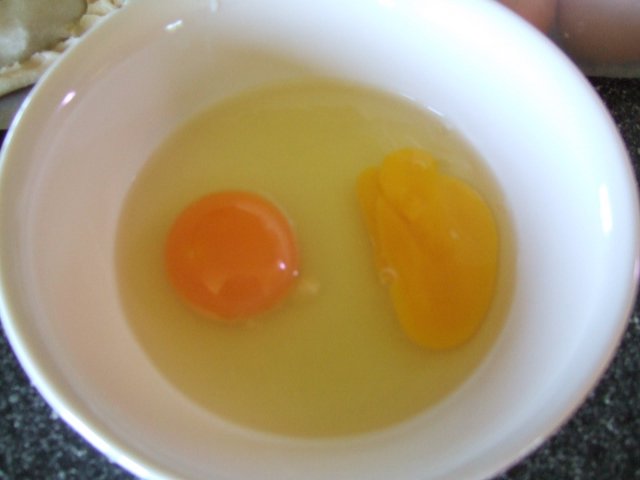
One time when I had lunch at my friend's house (with other Filipinas) I brought an egg with me (My eggs all come from my in-laws who raise chickens). Then I asked for an egg from my friend who was hosting the lunch, an egg which she buys from the grocery store. Both had brown shells. I wanted to compare and see for myself the truth in the photo in a magazine article my sister-in-law showed to me recently.

I was quite a bit careless when I cracked my friend's egg open; hence, the broken yolk. Regardless, it was still quite obvious how different the two are when placed side by side in this bowl.

I remember when I first came here, I was quite surprised at the almost-orange yolk, it made me wonder that maybe the brown shell had to do with it. Now I know better. And yes, that article reminded me about that first time I had an egg here. But during that time, I was comparing it to eggs that I was used to eating in the Philippines. This made me realize that those commercial eggs in PI are no better than the commercial factory farm-produced eggs here.

The physical appearance is only one clue as to the superior quality of eggs from chickens raised with tender loving care. A comprehensive comparison illustrated by a bar graph can be found in Mother Earth News's Chicken and Egg page. Nutrition-wise, they say:
In 1988, Artemis Simopoulos, co-author of The Omega Diet, found that eggs from
pastured hens in Greece contained 13 times more omega-3s than eggs from U.S.
supermarkets. In 1974, a British study found that eggs from pastured hens had 50
percent more folic acid and 70 percent more vitamin B12 than eggs from
factory-farmed hens. In 1997, a study in Animal Feed Science and Technology
found eggs from free-range chickens had higher levels of both omega-3s and
vitamin E than those from hens maintained in cages and fed commercial diets.
Most recently, in 2003, Pennsylvania State University researchers reported that
birds kept on pasture produced three times more omega-3s in their eggs than
birds raised in cages on a commercial diet. They also found twice as much
vitamin E and 40 percent more vitamin A in the yolks of the pastured birds.

Many vegetarians are forced to be so, even refusing to eat eggs because of cruelty to animals. While some cannot get themselves to slaughter (sacrifice) animals for their own consumption, others just plainly do not want to consume products raised under the most horrible conditions one can imagine (so they do not want to support such factory farms), as depicted in the video below, nor would they like to ingest such hormone-laden, probably previously sick products and have some dire health consequences.


Other related videos are the Meatrix I and II.

Have you noticed how the grocery stores are now teeming with "organic" produce? I am afraid it may be another "meatrix" where the produce is labeled as organic, but turns out to be another fantasy created by the profit hungry companies who want to take advantage of the "fad." If you feel at a loss now as to where to get foods you can trust (which can be quite a problem for the city dwellers), read here.

I feel privileged to have a taste of REAL GOOD FOOD, though not as completely as I would like it to be. Some people consider foods prepared in fancy restaurants as good food. To me, homegrown, safe, hormone-free, and healthy (as opposed to sick) nutritious foods are the real good foods.

I am contemplating on saving some money to have a contract with my SIL or MIL so they can raise chickens and pigs (in addition to beef) for my family's consumption (I do not have their expertise). There is also a local farm where the milk is organic and pasteurized (not homogenized). It may be quite costly, but the health benefits will be all worth it. Most of all, I will have the peace of mind on what I am feeding my family. Posted by Picasa

Thursday, February 03, 2005

Gallstones, Kidney stones and Hyperuricemia

I was operated before for my gallbladder stone (GB removed), and a consequent finding of my abdominal ultrasound then was the presence of a kidney stone about 1 cm in diameter. I had no histopath of the stone that was removed; we left the kidney stone alone. (My uncle-surgeon operated on me for free). I was thinking that the two stones might be related.


In formation of GB stones, there is the 4Fs mnemonic that I recall from Med school These enumerate the four F risk Factors that the patient might have to develop gallstones: Female, Fertile, Forty's and Fat. I was then 30 y.o. and certainly slim. So my RF were only that I was a female and at my reproductive age (not Fat, not Forty). I sought for other explanations, and I tried to link the two stones. I recalled that around 6 months prior to the diagnosis of my gallstone, I suffered from low-back pain that was not traceable to UTI nor lumbar problems, but which I could surmise to be secondary to my very very high levels of uric acid in my blood (hyperuricemia). Nirarayuma na ata ako...


I could also blame my infrequent sips of water...During those days when I often forgot about my thirst, thinking, "I'll attend to the next patient first then I'll drink," plus the lack of potable water save from bottled ones that I had to buy from the store across the street (nakakadyahe magpabili sa maintenance), I probably only was (unintentionally) able to drink about 6 cups of liquid (water, coke, coffee) per day or less...not much for a hot place on earth!


So along those lines (hyperuricemia and very little water intake, the latter contributing to concentration of urine formed, aggravated by procrastinating the bladder emptying) I deduced, without further laboratory tests, that my two stones could have resulted to the precipitation (due to low water level) of the uric acid crystals in my serum.


Of course I kept in my mind the guidelines for low-purine diet to lower my uric acid levels, but then, I recalled having read that most of the uric acid we have in our body came from our own production, and only minimally from dietary sources (I am telling you, if you are one hypertensive hyperuremic diabetic patient, you might die of starvation if you try to stick to the dietary guidelines!)


I believe that my usual food intake does not cause the alarming levels of my uric acid. Especially that my sister and an aunt also had gallstones and had their GBs removed.


After having visited Fanatic's blog on caffeine, uric acid and gout, I sighed a relief upon her re-affirmation of my belief that the dietary intake of purines account less significantly than my own body's production. And what is more comforting is the reassurance that I can continue to enjoy my coffee and may even increase its intake without subjecting myself to the "dangers" of forming uric acid crystals; on the other hand, it promotes excretion . Still, I have to develop the habit of drinking more water (at least 2 gallons a day!) for this purpose.


I remember after my operation while I was on duty, I was with a nurse who also had a prior Cholecystectomy (his was more complicated and he had multiple stones), and he told me that, "Pano yan, doktora, eh di tataba ka na rin? Di ba pati ate mo ganyan din. Tamo ang taba nya ngayon...tapos ako rin, tumaba."


Haha...I questioned his line of reasoning for that. To me, my lack of GB would mean that my bile (which helps in the digestion of fatty foods by emulsifying them so that digestive enzymes could find more surfaces to act upon) would come in steady stream to my small intestine, in contrast to the more controlled release by the gallbladder which contracts and releases bile in response to fat intake (hence those with stones usually feel painful spasms after eating deep-fried foods). So, if there is no fatty food, the bile has nothing to act on. If there is a high fatty intake, the bile will not increase accordingly, hence I will digest the fat less efficiently. More undissolved fat will pass through my intestines and will produce a diarrheal effect (oops, excuse me!). And since less fat is digested, less fatty acids (products of fat digestion) will reach my blood. Less fatty acids will be used to build up my fat reserves.


But I am getting thicker now especially that it is winter...You know why? I am eating way above my carbohydrate and protein requirement...I really badly need to move more and lessen my boredom...

Wednesday, October 20, 2004

What's in the Meat You Eat?

I saw an ad in Time Magazine about the Union of Concerned Scientists that is why I visited the place. They have several sections of interest, but I focused on the food for interesting reads which I can post here.
One of the articles focused on the use of antibiotics on livestock and poultry that may contribute to development of antibiotic-resistance among patients/people.
Did you know that approximately 70 percent of all antibiotics and related drugs

produced in the United States are given to livestock and poultry? These

drugs

are used for nontherapeutic purposes such as accelerating growth and

preventing

the diseases caused by overcrowded and unsanitary conditions on

"factory farms."

Unfortunately, this practice results in

antibiotic-resistant bacteria that can

cause difficult-to-treat diseases in

humans.


Read the whole article by clicking on the title.


The food section also features a Gallery of Foodborne-Illnesses.


There is also a discussion that addresses the risks of genetically engineered foods.


And I am more intent to learn more about Sustainable Agriculture. I may just continue my gardening in the future years, and I may try to learn how to raise my own pig/chickens/beef. I am glad I have something to start with - a family that grew up farming.


Other non-food related topics can be found on the said website - vehicles, environment, energy and security. I signed the Consumer Pledge to Reduce Antibiotic Use. I hope you will too.

Friday, September 17, 2004

The Food Chain

Be forwarned: This is not a recipe, not a kitchen tip, nor a health and nutrition tip.

After saying grace before meals, my younger son looked at the food on the table and asked me. "Ma, pwede ako mag-hotdog sandwich?" (I cooked steak, served with the usual boiled potatoes and boiled vegetables, which is the way my husband like his dinner most.)


I quipped," Anak, the best way to show God your appreciation for the food that He gives us is to eat what's on the table and avoid as much as possible wasting anything."


Quite reluctantly, he acquiesced, then, not looking directly into my eyes and with furrowed brows and puzzled look, he asked, "Ma, panong nanggaling ke God yung food? Di ba binili mo yung iba sa Hannaford, tapos yung iba sa garden mo galing? Tapos galing ke Grandma yung beef tsaka eggs natin, tapos yung milk galing ke Aunt Stacey?"


Is this scenario familiar to you? How do you approach it? How do you answer your child's questions?


Here's how I did it. I looked at it as another opportunity to teach my children about how the earth sustains us humans. What I told them was something like the stream of conversation presented below (and I have been repeatedly instilling the lessons in them)...


Do you believe that God created the Universe?

Opo.


Do you know that the sun and the earth and the other planets are in the Universe?

Opo.


Hindi ba, kaya tayo kumakain, para me energy kayo pag naglalaro, tumatakbo, nagba-bike, mag-pile ng wood, etc. etc.?

Opo.


Di ba pag di ka nakakain ng matagal, nanghihina ka, nauubos ang energy mo?

Opo.


Ganito kasi. Sa planet earth, the energy that we get ultimately comes from the sun, which is in the Universe that God made. But we can't go out on a sunny day and expose ourselves for a long time to try to get energy from the sun directly. That is not possible and will just create cancer of our skin. We have to get the energy indirectly. Here's how we get that energy.


Plants have the capacity to convert the sun's energy into a form usable to humans (and other animals). Some of that energy is stored in fruits (cucumbers, tomatoes, berries, apples, squash, zucchini), flowers (cauliflower, broccoli, squash), a bit in the leaves (pepper, spinach), some in their roots (like camote, potato, carrots, beets). Some plants we can't eat (grass, etc.) can be eaten by cows, goats, chickens, pork, deer, etc. which we can eat.


You see how the cows eat the grass and some other plants...


So we humans eat the stored energy in the plants' fruits and flowers and stems and roots,


Or we humans (and other animals in the upper level of the food chain) eat the animals that eat plants, like the cows that we call beef when it ends up on the dining table.


So if you want to make the same approach to your kids, please do so, and help them become more aware of how our very existence is sustained by the earth.

Here are some links about the


Food Chain and Food Webs (features an interactive food-web making that is printable)

and

Chain Reaction (What will happen if a living thing is removed in a food chain? Have fun with your kids trying this one.)

These will also help teach your children to respect other forms of life, because in so doing, we are preserving our very own species.

Isiningit ko po itong post na ito in between canning-related posts, despite this being a non-kitchen and a non-recipe post. I just felt the need to share this with mothers like me.


Saturday, August 21, 2004

Guide to Buying Chicken

Filipinas in the Philippines will not find this post of any use to them. It is just so easy to touch, feel, smell and see the chickens. The only things (that I am aware of) that market vendors do to the chickens to plump them up is to inject saline solution so that the chickens will weigh heavily.


Here, I found that I had no choice with the chickens available at the grocery store. The first time I tasted them, they tasted so foreign...they lacked the flavor that I was used to (in my opinion, our chickens in the Philippines are tastier. But of course, the Ams have their own opinion. It depends highly on which one grew up with). You see, few weeks ago we attempted to raise chickens for our own consumption (which my in-laws tried to take care of during the initial weeks), but the chicken barn burned because of the heat lamp (we assume) which they used to keep the chicks warm. Disheartened by the event (Mom felt so sorry for the chicks, she hoped they died quick and not had to suffer from the fire itself), we no longer felt inclined to raise chickens at least for this year. Okay....so I am back to buying chickens from the grocery store.


Prior to the burn, we would just get pre-cut packaged parts of chicken: skinless breasts for my husband and stepdaughter (he does not like red meat), legs/thighs/wings for me and my sons (I find them tastier. I don't care for the fat content because I easily use up my fat intake anyway. And although breasts are fine with me for sandwiches, they are much more expensive than the other parts, so I try to stick to the cheaper cuts which I like nevertheless.)


However, I read an article about a guide to buying chicken in Cook's Illustrated (this magazine is worth spending on: the authors try to dig deeper into recipes, seeking reasons why so and so procedures are better; they rate equipment according to results and make recommendations as per the best performance as well as per the best value. I recommend it.) It said:

Whole birds taste better than packaged parts and cost less, so it makes

sense to cut up chicken at home.

Even when a recipe call for chicken parts, there are many advantages to purchasing a whole chicken and cutting it up yourself. Packaged chicken parts are generally mass-produced and are of a lower quality, so buying a whole chicken gives you the chance to buy a better bird. In addition, packages of chicken parts often come from different chickens of different sizes; as a result, the pieces may cook unevenly. To top it off, whole chickens generally cost less per pound and provide trimmings that are perfect for freezing to make a homemade stock.


Hmmm...why did I not think of that before? I am quite experienced in cutting a whole chicken anyway. And that way would give me a chance to store the giblets (for the liver to be used in gravies, and for the gizzard for adobo). We Filipinos are quite known by some foreigners as not letting food go to waste (They think it bizarre or even gross that we want the chicken back, feet, intestines, liver and gizzard. They don't even know how much tastier a big fish head is compared to fillets! Oh, that grosses them out. I miss the "ulo-ulo" sinigang.).


And on I read...


BUYING THE RIGHT-SIZE BIRD

Producers breed chickens to "plump out" (an industry term indicating that

the breast meat is thick and plump) at different ages, depending on the desired

weight of the slaughtered bird. We have found that certain sizes (usually

described by producers with the terms below) work better for certain

recipes.


Poussins are baby chickens that weight about
1

pound
. Generally available only at specialty stores or butchers, they are

ideal for one person.


Cornish Game Hens are slightly older than poussins and

weigh between 1 and 2 pounds. Larger game hens will serve two people, but

these birds are usually mass-market brands that lack the flavor of the smaller

poussins.


Broiler/fryers are the standard supermarket chicken. They

generally weigh between 3 and 4 1/2 pounds and will serve four people.


Roasters generally weigh between 5 and 8 pounds.

Despite their name, we do not recommend roasting birds this large, as

the outer layers of meat tend to overcook before the meat near the bone reaches

a safe internal temperature. When feeding a crowd, we prefer to buy two

broiler/fryers.


For their recommendations:


HIGHLY RECOMMENDED

Empire Kosher Broiler Chicken - $2.29/lb; "perfectly seasoned," with meat that was "moist" and "tender"

RECOMMENDED

Bell & Evans Fresh Young Chicken - $2.69/lb; raise on an all-vegetable, antibiotic-free diet, praised for meat that tasted "clean" and "fresh"

Tyson Fresh Young Chicken - $1.29/lb; some tasters liked the "firm" texture, others found it slightly "mealy"


So I tried buying a whole chicken yesterday, but the grocery store brand (Hannaford). Vacuum-packed and not frozen (it was recommended to be frozen by Aug 23 ), I got the 4.4-lb, which cost $4.39 at $0.99/lb. It appeared to me like the chickens I used to buy in the PI. I cut it up. I smelled it. I now feel at ease with this whole chicken. Suddenly I felt like they are no longer foreign to me. I would have cooked them for lunch today but my hubby suddenly requested to have the Mac & Cheese and Chicken Nuggets (Weaver brand) that he bought (I have ready-made comfort foods but he loves them!). I will have to cook tinola using pepper leaves tomorrow then. So I can make my own feedback about them whole chickens after that.


Tuesday, August 03, 2004

Spice Rubs and Marinades for Steaks and Others

My husband is used to having steaks flavored with just pepper and salt. The Filipina in me is not quite satisfied with just pepper and salt. So while I cook my husband's steak with just S&P, I cook mine and my sons' with spices or marinated, then let my husband taste them. So far his tastebuds have accepted and appreciated the new flavors, and actually have at times asked for the marinated/rubbed piece, but still goes back to that which he grew up with: steak seasoned with S&P.


Well, I still love trying new flavors, and would still want to expose my children to a wide variety of food. I often tell my sons that when they grow up, I would not want them to be fussy eaters, as that would give their future wives a hard time. So I continue exploring.


I suggest other moms have in their pantry some of these spices in small quantities (it's always best to use them freshly made spices, than having all of them in big quantities but which will count years before total consumption). I usually get my dried spices from "Spice of Life" outlet near me. They sell these spices on a per weight basis, and at a much cheaper price than those branded found in grocery stores (Hannaford in my area).


Here are some spice rubs for grilled steak (from Cook Illustrated Magazine):


Chile-Cumin Spice Rub


3 dried chipotle chiles, stemmed, seeded, and cut into rough pieces, then ground together with


2 dried ancho chiles, stemmed, seeded, and torn into rough pieces


1 tbsp ground cumin


1 tbsp table salt


2 tsp sugar


Click on this post's title to see a pinter-friendly list of these rubs and marinades which I compiled from 3 sources.


Wednesday, July 21, 2004

Pag Mataas ang Presyon Mo, Bawal ang Maalat...

Actually, mahaba ang litanya ng mga "bawal" sa mga taong may hayblad (high blood pressure po! aka hypertension). "Bawal ang maalat" is just one in the long list of pointers given by the doctor. (other bawals: mamantika, sigarilyo, especially when there's heart complications: bawal masyadong magpagod, bawal masyadong matuwa, etc., etc.)


Usually the doctor does not really bother to explain the why's of each pointer. Aside from being time-consuming (and there is a queue of patients waiting for their turn), the explanation can be so technical, and can lead to further explanations.


Pero sige, focus tayo sa MAALAT (salty) and its relation to hypertension.


Alam nyo ba, kahit sa medisina, me math? And that's not limited to calculating the charges for each item and hours spent during the consultation, the calculations for pediatric dosages...even during the first year of study, many would-be doctors would be dismayed to find out that they are not spared from  mathematical (specifically physics, more specifically in this topic, fluid dynamics) concepts.


Blood Pressure has an equation:


BP = CO x PR


where

  • BP = blood pressure
  • CO = cardiac output (yung dugo na binobomba palabas ng puso), and
  • PR = peripheral resistance (this is the tendency of the arteries to resist the incoming blood from the heart)

This means that blood pressure is influenced by these two factors.

Cardiac output also has an equation:

CO = HR x SV

where:

  • HR = heart rate (bilis ng tibok ng puso)
  • SV = systolic volume (dami ng lamang dugo ng puso bago mag-pump)

If you combine the two equations,

BP = HR x SV x PR

So there are 3 factors that operate in increasing the BP:

  • HR - can be increased, for example, by exercise, extreme emotions like fear, anger and excitement
  • SV - can be increased by increasing the blood that flows back to the heart (ex.: elevate your legs, lie down, position yourself upside down, increasing fluid intake and salt intake - but these are usually temporary. The normal body tends to compensate through other woderful mechanisms to bring back the pressure to the normal levels as efficiently as it can)
  • PR - can be increased by decreasing the diameter of the arteries (kaya kung me atherosclerotic plaque, liliit and butas na dadaanan ng dugo), having stiff arteries ( ex. pa rin ang me atherosclerosis), vasoconstriction (constriction of arteries as in nicotine's effect on the circulation - kaya kawawa ang baby ng mga buntis na naninigarilyo)

(For more readings on blood pressure physiology, here is a good educational website by an anatomy and physiology academician)

In human physiology, the two major cations (positively charged ions) are Na (sodium) and K (potassium) ions. They directly affect the normal functioning of all cells.  Na is the main cation in the extracellular fluid (nasa labas ng cells, meaning nasa dugo, in-between ng cells, basta wala sa loob ng cells). K is (nahulaan nyo na siguro) the main cation inside the cells. And when we talk of these ions, we are concerned about electrolyte balance (narinig nyo na siguro ito pag me diarrhea kayo at kelangan nyo ng oresol).

From Martini's Anatomy and Physiology:

The total amount of sodium in the ECF represents a balance between two factors:

  • Sodium ion uptake across the digestive epithelium. Sodium ions enter the ECF by crossing the digestive epithelium through diffusion and carrier-mediated transport. The rate of absorption varies directly with the amount of sodium in the diet.
  • Sodium ion excretion at the kidneys and other sites. Sodium losses occur primarily by excretion in urine and through perspiration. The kidneys are the most important sites of Na+ regulation. (Kaya bawal din ang maalat sa me sakit sa bato.)

A person in sodium balance typically gains and loses 48–144 mEq (1.1–3.3 g) of Na+ each day. When sodium gains exceed sodium losses, the total Na+ content of the ECF goes up; when losses exceed gains, the Na+ content declines. However, a change in the Na+ content of the ECF does not produce a change in the Na+ concentration. When sodium intake or output changes, a corresponding gain or loss of water tends to keep the Na+ concentration constant. For example, if you eat a very salty meal, the osmotic concentration of your ECF will not increase. When sodium ions are pumped across your digestive epithelium, the solute concentration in that portion of the ECF increases, whereas that of the intestinal contents decreases. Osmosis then occurs. Additional water enters the ECF from the digestive tract, elevating blood volume and blood pressure. Thus, persons with high blood pressure are advised to restrict the amount of salt in their diets.

Ngayon, hindi lang "maalat" ang equivalent ng "restrict the salt intake". In particular, pay attention to the sodium content of your food. Gaya ng MSG (monosodium glutamate), peanut butter, etc. To see a list of sodium-rich foods, click here.

Gets nyo na? Kaya kayong me hayblad, WAG MATIGAS ANG ULO (If you still need more convincing to lower your BP, ask doc emer about the complications of HPN.)

Tuesday, June 29, 2004

Some Kitchen Cleaning Tips

From Martha Stewart Living Mag:


SOFTEN MINERAL DEPOSITS - Place paper towels or sponges soaked in full-strength vinegar or lemon juice over crusty build-up around faucets. Leave in place for an hour or so. Then scrub deposits away.


KILL GERMS - You can safely and effectively sanitize countertops with white vinegar and hydrogen peroxide. Spray the surface with one, then the other, and wipe. It doesn't matter which goes on first, but keep them in separate bottles and do not dilute.


SCRUB AWAY KITCHEN STAINS - Make a paste of 3 parts warm water to 1 part baking oda. With a damp sponge or cloth, rub it onto the surface to be cleaned, then rinse. Use to clean laminate countertops and refrigerator surfaces, to remove grease from pots, and to shine chrome and stainless steel.


Beef Cuts and Methods of Cooking

When my hubby's family had one of their cattles slaughtered for our own consumption, suddenly I had a freezer-full of various beef cuts - ground, soup bone, steaks (minute, cube, top round, rib eye, porterhouse, tenderloin, T-bone) and roasts (rib eye, chuck, sirloin, etc.). We did not have cuts for stewing, though. My husband did not care for them. (But next time, I will ask that we have them, too. )
I panicked at the time...I had to learn how to cook which cut. As usual, the internet came to the rescue. Click on this post's title to see the fully-illustrated beef cut chart.


Beef.org have these as tips for home-storage of beef:


Refrigerate or freeze beef as soon after purchasing as possible.

(If it will take longer than 30 minutes to get it home, keep it cold

in a cooler in your car.)


If refrigerating beef, place it in the meat compartment or in the

coldest part of the refrigerator.


If purchased beef is wrapped in transparent film, it can be refrigerated

without re-wrapping. It can also be frozen up to 2 weeks without

rewrapping. For longer freezer storage, to prevent freezer burn,

repackage in heavy-duty aluminum foil, freezer paper or plastic

freezer bags, removing as much air as possible.


Label and date frozen beef packages, including weight and/or

number of servings. Practice the FIFO inventory system

- first in, first out.


Do not defrost frozen beef at room temperature. Defrost frozen beef

in the refrigerator, to prevent bacterial growth. Place package on

a tray to catch any drippings and place in refrigerator the day

before it is needed.


Allow about 24 hours to defrost a 1 to 1-1/2-inch thick package of

ground beef or beef pieces.


Allow 12 hours to defrost 1/2 to 3/4-inch thick patties.


Allow 12 to 24 hours to defrost steaks, depending on thickness.


Allow 4 to 7 hours per pound to defrost large oven roasts or thick

compact pot roasts.


Allow 3 to 5 hours per pound to defrost small oven roasts or thin

pot roasts.


Cook ground beef as soon as possible after defrosting.


Refrigerate leftovers promptly after serving, within 2 hours

after cooking. To speed up the chilling, divide large quantities into

smaller portions or spread food out in shallow container.


Remember that ground beef, beef for stir-fry, beef for stew and beef for kabobs are more perishable than whole muscle cuts (roasts and steaks). During the grinding process for ground beef, any bacteria on the surface are mixed throughout. Cutting into strips or cubes creates more exposed surface area for bacteria to grow on. Both processes result in shorter shelf life.


And further has these beef-cooking tips:

Cooking Basics


--------------------------------------------------------------------------------


Getting It Ready

Follow these smart handling tips when preparing beef.


Leave a thin layer of fat on steaks and roasts during cooking to preserve juiciness. Trim fat after cooking.


Pat steaks, cubes and pot roasts dry with paper toweling for better browning.


To make cutting into strips for stir-frying easier, partially freeze beef to firm.


Salt beef after cooking or browning. Salt draws out moisture and inhibits browning.


--------------------------------------------------------------------------------


Keep It Clean

To avoid cross-contamination and prevent foodborne illness, follow these easy steps.


Wash hands well in hot soapy water before and after handling meat and other fresh foods.


Keep raw meat and meat juices from coming into contact with other foods, both in the refrigerator and during preparation.


Wash all utensils, cutting surfaces and counters with hot soapy water after contact with raw meat.


Keep carving boards separate from other food preparation or serving boards.


--------------------------------------------------------------------------------


Equipment Basics

Having the basics and knowing when to use them can make all the difference.


Choose pans that are thick enough to heat evenly without scorching.


Size matters! For best results, use the pan size specified in the recipe. If the pan is too small and beef is crowded, browning will be inhibited. If the pan is too large, overcooking may result.


Nonstick pans are easier to clean and they allow cooking with less fat.


When cooking with acidic ingredients, use pans with a non-reactive interior surface, such as nonstick, anodized aluminum and stainless steel. Reactive metals such as aluminum and cast iron can affect the taste and color of dishes with acidic ingredients.


Place beef on a rack in the broiler or roasting pan to allow fat to drip away during cooking.


Use an oven thermometer to verify that your oven is accurate.


--------------------------------------------------------------------------------


Adding the Heat

The key to successful beef cookery? Choose an appropriate method for the cut you have selected.


For tender cuts, dry heat methods such as grilling, pan-broiling, broiling, oven roasting and stir-frying are best. Undercover cooking methods – braising, pot roasting, stewing – use moist heat and are better choices for less tender cuts. For quick easy reference, see our table below.


Once you have selected a cooking method, follow these helpful tips for tender, juicy, flavorful beef dishes.


High heat can overcook or char the outside of beef cuts while the interior remains underdone. For tender beef, cooked to the desired doneness, use medium-high heat for stir-frying, medium heat with all other dry heat cookery methods and low heat for moist heat methods.


Turn steaks and roasts with tongs, not with a fork. A fork pierces the beef, allowing flavorful juices to be lost.


Turn ground beef patties with a spatula. Do not press patties. Pressing causes the loss of flavorful juices and results in a dry burger.


Cooking times in our recipes and timetables are based on beef taken directly from the refrigerator.


Cooking times for gas and electric ranges are comparable. However, since individual ranges perform differently, it is important for you to become familiar with your own range.


Grilling times in our recipes and timetables are based on charcoal grilling. Because gas grill brands vary greatly, it is best to consult your owners manual for gas grilling guidelines.


Although I don't buy beef from the grocery store, some Filipina readers might find the following info from USDA useful:


Each USDA beef quality grade is a measure of a distinct level of quality -- and it takes eight grades to span the range. They are USDA Prime, Choice, Select, Standard, Commercial, Utility, Cutter, and Canner.


USDA Prime, Choice, Select, and Standard grades come from younger beef. The highest grade, USDA Prime, is used mostly by hotels and restaurants, but a small amount is sold at retail markets. The grade most widely sold at retail is USDA Choice. However, consumer preference for leaner beef has increased the popularity of the Select grade of beef. Select grade can now be found at most meat counters.


Standard and Commercial grade beef frequently is sold as ungraded or as "brand name" meat.


The three lower grades -- USDA Utility, Cutter, and Canner -- are seldom, if ever, sold at retail but are used instead to make ground beef and manufactured meat items such as frankfurters.


My favorite websites for beef recipes are http://www.cabprogram.com/food/recipes.html and

http://www.beefitswhatsfordinner.com/recipes/default.asp .


Enjoy your beef!

Thursday, June 17, 2004

Food Poisoning

When I was still practicing as a GP in the Philippines, I often had patients who manifested with severe nausea and vomiting, and usually they came to the clinic looking very weak due to dehydration and electrolyte imbalance. History usually revealed eating food bought from karinderya or a fast-food restaurant (I had it when I bought king congee at a fastfood whose name I have forgotten - tumatanda na ako!. It offers Chinese dishes like siopao and pancit. Maybe some of you remember?) Some patients with the same symptoms consulted at the same time (My patients then had history of eating halo-halo bought near the talipapa.)By the time they consulted, they had gotten rid of the toxin, and once hooked to IV Fluids, almost readily felt better. They thought the IVF was a medicine, but actually the rehydration and restoration of electrolytes made them feel better, plus, the nausea and vomiting had stopped, which they often thought was secondary to the IVF but actually because the illness had resolved spontaneously. Well, the IVF also encouraged the highly-irritated bowels to rest.)


I recalled those events because of this eDiet Health Tip from My Yahoo:


Food poisoning can be downright deadly. Before handling raw poultry, seafood, meat or eggs, always wash your hands in hot, soapy water. Check to see that your refrigerator's thermostat is set to 40 degrees or below. Do not thaw foods at room temperature, but rather defrost them in the refrigerator. Wash the cutting board with hot, soapy water when using it for a variety of foods.


And I add: Always reheat thoroughly leftover foods that were refrigerated prior to consumption, especially if they had been cooked or prepared more than 12 hours. For mayonnaise- or egg-containing food like salad or some frosting, consume as fast as you can and keep refrigerated. If they had been sitting at room temperature for more than 2 hours, throw them away unless you intend to reheat them (I especially like toasting bread with mayo-egg or mayo-cheese using the oven-toaster).


To give you more information on Food Poisoning, read this page from the Merck Manual website.


You may also look at the US FDA website on the said topic, particularly for those etiologic/causative agents not mentioned in the Merck Manual.


If you happen to have the symptoms, be prepared to recall where you last ate and what items you had. So if you happen to eat at restaurants often, keep the receipts within at least 2 weeka. You may have to use them.


 Posted by Hello
Custom Search