Being crunched for time, I have to think nowadays of what I can fix quickly, easily, without need for too many ingredients. Here is one of them. My sons and I love shrimps, so I fix seafoods at times, and fix something else for hubby and stepd (or have TV dinner for them).
Ingredients:
1 lb pasta, prepared as directed (I used rotini here, but you can use linguine or farfelle) 1 lb large shrimps, shelled 1 each of zucchini and summer squash 1-2 tbsp butter salt, pepper and ground basil leaves 1 jar (15 oz) Classico Roasted Garlic Alfredo Sauce 1 can (~12? oz -- I forgot to take note) of Campbell's condensed cream of shrimp Enough water to thin the sauce a bit (1/2 cup to 3/4 cup)
Instructions: While cooking pasta, melt butter in saucepan, add zucchini, summer squash and the shrimps and stir fry until shrimps turn pink (about 2-3 minutes). Do not overcook, or shrimps get rubbery. Remove from pan, transfer to a bowl, and set aside. Keep warm, Pour into the saucepan both sauces (alfredo and condensed cream). Add enough water to thin as you desire, stir until boiling. Turn off the heat. Serve on pasta and add the shrimps/veggies on top. Consume immediately.
I was craving for some vegetable-based dish one day, then one of my co-workers left a gallon bag full of fiddleheads inside the fridge for anyone interested to take home. The unit sec and I decided to divide that. That's what I cooked in a laing-inspired fashion, although I decided to add some vinegar toward the end of cooking.
My craving was satisfied, and my sons enjoyed it as well.
Ingredients: 1/4 lb pork liempo, sliced thinly 3 cloves garlic, minced 1 medium onion, sliced 2-3 tbsp patis (fish sauce) 1 (13.5 oz) can premium coconut milk (first press) 1/2 cup to 1 cup water qt fiddle heads salt and pepper to taste dash of ground basil leaves 2-3 tbsp cider vinegar
Instructions: Add about 1/4 cup water to pork and sautee until pork renders fat. Add salt and pepper. Add garlic and sautee until light brown. Add onions and sautee until caramelized. Add patis and let sizzle. Add coconut milk and fiddle heads. Add about 1/4 cup water and stir. Let simmer uncovered until coconut turns creamy (add water if it turns too dry). Season with salt, pepper and ground basil leaves. Add vinegar and let simmer another 5 minutes. Serve with plain rice.
I do not need to post a recipe here. I just bought some sea scallops (medium-sized)for grilling, instead of the bay scallops (smaller ones) that are my hubby's fave variety, because he says they are tastier. The medium size is just right for the skewers, and I think they are tasty as well (the bigger ones are definitely not!). I wrapped each individual scallops in bacon, held in place by the skewer, 4 pieces in one skewer. I grilled on high heat until bacon was done. Scallops easily cook anyway, and at first I was afraid of high heat, thinking it might dry up the scallops while taking quite sometime cooking the bacon. But I was wrong. It seems that the fat of the bacon kept the scallops moist. The scallops also did not brown as much (in contrast to when I pan-fry them in butter).
Though my husband tends to stick to his basic traditional foods (pan-fried scallops for him), he could not resist but try (especially that he liked the bacon-wrapped dogs), and actually liked these bacon-wrapped scallops.
As a side dish, I boiled sweet corn (nobody here likes grilled corn), and I prepared summer squash and zucchini coated with olive oil and sprinkled with Italian dressing, then roasted on the grill atop a roasting pan with holes, cooking at the same time scallops were. The kids found them delightful (they were surprised!).
When I do cut up a whole chicken for purposes of cooking adobo or BBQ, etc., I end up with the chicken back, which is mostly bones and very little meat. Sometimes I boil the whole thing for stock (and later on get the meat for arroz caldo or mami), but sometimes I patiently try to cut the meat off the bones for use in stir-fries.
Since this is a season to get fresh zucchini (and summer squash) from the grocery stores, it is a good time to stir-fry them together.
Ingredients: 1/4 to 1/2 cup of bite-sized chicken meat, marinated with soy sauce (enough to coat) for 30 minutes 1 small zucchini 1 small summer squash 2 tbsp oil 2 stalks celery 1 small onion red and yellow bell peppers (I used a handful, diced) 1 cup cold chicken broth, mixed with 1 tbsp cornstarch (have extra mix of 1/4 cup broth with 1 tbsp cornstarch just in case you still need to thicken) salt and pepper to taste
Instructions: Slice all veggies as shown on photo. Heat wok or skillet on medium, add oil and let heat up. Stir fry onion and celery until translucent, add the chicken and cook until chicken is browned. Add zucchini and summer squash, and the bell peppers and stir-fry about 1 minute. Stir in chicken broth/cornstarch mixture and cook until thick (or you may have to add some more broth/cornstarch mixture). Season with salt and pepper to taste.
I really did not feel like posting about this, since the recipe for Pancit is now ubiquitous. This recipe is not at all special over the others, I am sure. However, some co-workers were very interested after having a taste (despite some of them hesitating at first to taste pancit then became converted). Plus, keeping in mind that my kids might someday want to cook this and will have to refer to my online kusina for guidance, I am now compelled to post my recipe here, the way I prepare pancit.
For noodles, I either use bihon or sotanghon, with or without canton. The rest of ingredients and the method are practically the same for all these types of noodles. For my non-Filipino audience, the sotanghon (bean vermicelli) is probably the most accessible, even available at Hannaford (sometimes, a Japanese version is available, although more expensive). I get mine from Spice of Life. The bihon and canton are noodles I get only from the Asian stores in Portland.
For the stock, I use a combination of chicken and lobster, which I prepare (usually with minimal salt) ahead of time and freeze for future use.
Meat can be chicken (I use leftover roasted chicken) and/or pork, and I love combining with shrimps.
For veggies, I like using garlic, onion, and tomatoes as basic for sauteeing. The rest of the veggies may be a combination of carrots, sugar snap or snow peas (alternative is green beans), bell peppers, and either napa cabbage (I prefer this) or regular cabbage.
Ingredients: (approximate) 3 tbsp oil 6 cups chicken stock (with or without lobster; if using, may use half of each); have extra on hand in case you will need more) 1 pkg (500 g) bean vermicelli (sotanghon) 1 pkg (16 oz) pancit canton 3 cloves garlic, sliced 1 medium onion, sliced 3 medium tomatoes, sliced 1-2 cups cooked chicken (or you may want to sautee this first before the above veggies) 1 lb shelled shrimps 1 carrot, sliced thinly 1 cup sliced bell peppers 2 cups (or 1 small pk) snap peas or green beans 1 napa cabbage, cut crosswise in strips 6 tbsp oyster sauce (I got the idea from MaMely) soy sauce, salt and pepper to taste 1 tsp sesame oil
OPTIONAL green onions, sliced, for garnishing kalamansi and patis or toyo for further taste adjustment (mainly for Filipino eaters; I would if I were in the Philippines; I do not have access to kalamansi here.)
Instructions:
Soak the bean vermicelli in very hot tap water for about 25 minutes then drain.
Heat oil and sautee garlic until fragrant, then onions until translucent, then tomatoes until they caramelize. Add carrots, snap peas/beans, and bell peppers and stir fry 1 minute. Add chicken/lobster stock and let boil 1 minute. Add shrimps and cook 1 minute, then add napa cabbage and cook another 2 minutes (or until shrimps are cooked). Dish out the veggies/meat. Adjust taste of stock by adding oyster sauce, soy sauce, salt and pepper. Making sure stock is in brisk boil, add pancit canton followed by sotanghon and cook for about 2 minutes (or until noodles are cooked), stirring constantly. Do not overcook. Drizzle the sesame oil and transfer to a plate. Arrange the meat/veggies as topping. May add green onions as topping.
Note: I made this when I thought my son's classmate (of Filipino parents) would be staying for lunch (they were supposed to work on their science fair project). Just as I placed the noodles, the foster parent came to get the classmate, and I sort of overcooked the noodles because of the distraction. It still turned out great, apparently. I packed some and asked my kids to bring to my in-laws. They loved it. I brought the leftover to work that night (because a co-worker wanted the recipe, but she was not working that night, sorry for her), and my co-workers that night loved it. One could not stop saying how good it was. The others were not too open to new dishes (like my husband) so they tasted just the noodles (not into veggie/meat/shrimp mix, apparently) and loved the taste nevertheless.
I have said this before: Ground beef sauteed with salt and pepper (no other spices), boiled potatoes and brocolli is a typical favorite meal of my husband, much in the same way that fried fish, plain rice and tomatoes or camote tops is a typical favorite Filipino meal.
Because of this, I often would cook this for my husband when I have a Filipino type of meal for my kids and I. Quite expectedly, he would always have about half of the ground beef leftover. This I make into torta, or re-sautee with garlic, onions, and tomatoes, and add beef broth and greens, usually native pechay (bok choy) cut into strips, and with the optional addition of sotanghon noodles, season with salt and pepper as needed. My kids and I love this (in fact, they sometimes request that I make this. They are just fond of soup-ish veggie-dominant dish.)
A good substitute for ginisang munggo, lentil is faster to cook and tastes and feels almost like mung beans. Ingredients: 1-1/2 cups of lentils 3 tbsp oil 3 clovces garlic, sliced 1 medium onion, sliced, 2-3 medium tomatoes, sliced 1/2 lb shelled shrimps (or more, if you like) 2 cups chicken broth (or as desired dash of ground basil a bunch or a package of spinach salt and pepper to taste
Instructions: Wash lentils and soak for at least 30 minutes (up to one hour) with water double the amount of the lentils. Drain.
Heat oil and sautee garlic, onions and tomatoes. Add the lentils and broth; simmer for 10 minutes (or until lentils are soft enough for you; I prefer mine with a little resistance). Season with salt and pepper as necessary. Add a dash of ground basil.
During the last two minutes of cooking, add the shrimps and stir until shrimps turn pink. Turn the heat off. Add the spinach and stir to wilt. Enjoy with plain rice.
I always have the craving for laing when I feel like going mostly vegetarian (mostly because I am and never will be a pure vegan), usually when I want to lose some weight.
However, being too far from Asian stores, and actually never really finding the dehydrated taro leaves in this state, I looked at some of the greens available in the grocery store and felt them with my fingertips, trying to imagine their consistency in comparison with fresh taro leaves. The collard greens seemed close enough...and I started my quest in finding a good substitute for taro leaves in cooking laing.
I have friends who have tried fiddleheads for this mainly-veggie dish, paired with pork. But for some reason, I get dizzy eating fiddleheads. It must have some component that did not agree with me.
I also have cooked spinach haddock laing, although it was heavier on haddock, so it was like a marriage between fish chowder and laing, using coconut milk instead of milk or cream. It was one of the recipes I submitted to Hannaford when they interviewed me for the "Food Lover's Favorite" column in fresh magazine.
But I really wanted a leafy type of veggie to make this dish with. Collard greens seemed like a good substitute.
I am posting here a procedure that I think will give me a better outcome. When I tried cooking this, I did not realized that the collard greens took a lot of time to cook to the tenderness I desired, and in effect, the fish was overcooked, and the coconut milk almost turned all the way to oil (I want it to reach only the creamy stage, not oily). So with the following revision in the procedure, I hope to next time cook this again, hoping that the results will be what I had hoped to achieved. Because after the "getting-to-know-you" stage (I admit I was not too fond of the veggie at first, because it somewhat left a subtle hint of bitterness, maybe because it was not fully cooked), I have come to love the taste of it on the subsequent days when I had it for lunch.
Ingredients: 1 bunch collar greens, cut horizontally in strips (separate the hard stems from the greens) 3 tbsp oil 3 cloves garlic, sliced 1 onion, slilced 3 tbsp (roughly) equivalent slices of ginger root 1 pound haddock, sliced (or you may purchase chowder cut;they are cheaper) 1 cup water (or enough to half cook the greens) 1 can premium coconut milk 3 tbsp patis (fish sauce) salt and pepper to taste
Instructions:
In a wok, sautee the ginger and garlic in hot oil. Follow with onions and cook until translucent. Add patis and let sizzle. Add 1 cup water and the stems. Let boil for about 5 minutes. Add the greens and stir. Let boil until just past half-cooked (I'd say about 10 minutes). You may have to add some more water to make sure it does not dry up. Add the coconut milk and let boil for about 5 minutes uncovered. Add the fish cuts and let cook for about two minutes or so (do not overcook). Enjoy with plain rice.
I have been having cravings for veggies lately because I feel heavier...I need to cut down on fats and meat, and instead stuff myself up with more fiber and vitamins.
If I were in the Philippines and someone asked me what this was, I would have answered, "ginisang gulay" or "lutong bahala na," but I am posting it anyway in my blog, with a more appropriate name. Actually, both summer squash and zucchini are categorzed into "summer squash," in contrast with winter squash, where butternut squash (and other hardy varieties) would fall into, the kinds that keep good in the pantry. This is so easy and good, even my kids love it. I just got about an ounce of meat thinly sliced off a frozen steak which I later on cooked as bistek tagalog (which reminds me, I have not posted a recipe here for bistek!). Ingredients 2 tbsp butter 1-2 oz thinly sliced beef (or whatever meat or seafood; added for flavor) - optional 1 stalk celery, cut in half longitudinally then cut into small cubes 1/2 each of red and green bell peppers (I used frozen ones), diced 1 zucchini, cut in wedges 1 summer squash, cut in wedges (the longitudinal one like zucchini, but you may want to use the sunburst?-like type) 3 tbsp Kikkoman stir-fry sauce (or to taste) dash of pepper
Instructions Heat wok on medium for about 5 minutes. Add butter until clarified. Stir-fry beef for 1 minute. Add celery and bell peppers and stir-fry for about 1 minute. Add the summer squash and zucchini. Stir fry for bout 2-3 minutes. Add stir-fry sauce and stir. Season with pepper.
I have no easy access to kangkong (water spinach) where I am now. But I do have a craving for this vegetarian recipe from time to time, especially when I feel I have too much baggage around my waistline, hehe...
So one day I cooked adobong asparagus for lunch. One bunch of asparagus was too much for lunch. So I had leftovers which my older son saw and tasted as soon as he got home. He told me, "This is good, Ma! It tastes familiar." I reminded him about adobong kangkong which we used to have back in the Philippines. "O, now I remember!" was his reply.
It was sooo good, in fact, that I probably will not anymore buy kangkong from a store two-hour drive away from me for the purposes of satisfying my craving for this veggie dish.
UPDATE as of 10-07-09: This dish is well-loved now by at least two readers, and one of them, Sharon, even blogged about it (and about me -- thanks for the heaps of praises, Sharon!). Sharon's blog also has some very interesting baking recipes, although she says she is a newbie (I'd say she does great in baking, even better than I do, but she does not seem to believe that she is that good already). She has another blog which focuses on French to English translation (and actually works as F-->E translator). Her posts are very informative, and it is very apparent how erudite she is!
Ingredients: (all approximations) 1 bunch asparagus(sorry I forgot to take the weight, about the diameter of the circle you form when joining your two thumbs and middle fingers) 2 tbsp oil 3 cloves garlic, sliced 1/4 cup soy sauce 1/2 cup vinegar freshly milled pepper to taste pinch of salt
Instructions: Heat wok at medium setting for about 5 minutes while you prepare garlic and asparagus. Cut off the tips of asparagus about 3 inches, then chop the rest at 2-3 cm intervals down to the tough parts. Discard the tough parts of stems. Rinse well under cold water and let drain. Heat oil for about 30 seconds and sautee garlic until light brown. Add asparagus and stir-fry about 3 minutes. Transfer veggies in a bowl/platter and keep warm. Pour soy sauce and vinegar to the wok and let simmer on low heat for about 5 minutes untouched. Place back the veggies into the pan carefully on top of the soy sauce-vingear without stirring. Sprinkle the freshly milled black pepper on top and add a pinch of salt. Let simmer uncovered without stirring for 3 minutes. Finally stir some more and turn off heat.
Serve with plain rice. Enjoy as is if you are trying to lose weight, or enjoy with a good protein source.
One of my favorite veggie-based dishes that is similar to the way I prepare guisadong munggo, I just interchange the black-eyed peas with green mung beans. Although distinctly different in taste, they both taste awesome to me, and my kids love it.
Ingredients: 1/2 cup black-eyed peas, cooked 1 tbsp oil 1/4 lb pork, sliced thinly (or use ground) 3 cloves garlic, sliced 1 medium onion, sliced 3 medium tomatoes (or 1-2 big), sliced 1 cup chicken broth (or water), or as you deem necessary 1/4 lb shrimps, shelled salt and pepper to taste dash of ground basil 1 zucchini, sliced thinly
Instructions: Soak black-eyed peas for 30 minutes. Drain and rinse well. Add water enough to cover up to about 1 inch above the BEP and boil, then lower heat to simmer 30-45 minutes or until done, stirring occasionally, making sure you don't run out of water.
When BEP are done, heat oil and sautee pork for about 5 minutes or until brown and tender, followed by garlic then onions until translucent. Add tomatoes and keep stirring. When tomatoes turn saucy, add the BEP, broth/water, salt and pepper, and ground basil. When boiling, add zucchini slices and shrimps and cook uncovered, stirring frequently until zucchini is tender and shrimps turn pink.
Catfish is one of the few fish variety that goes really really well with coconut milk cooked until creamy. I love it also grilled, because it's high fat content just makes it so ideal for grilling, and gives its yummy taste. Hubby never likes fatty fish, though.
My sons also love this ginataang hito. If not for the tedious task of removing fish bones, they would not really have anything against any fish dish I prepare. They love anything seafood.
Ingredients:
2 catfish, cut into serving pieces 3 tbsp oil 3 cloves garlic, sliced 2 tbsp sliced and mashed ginger 1 onion, sliced 1/2 cup unsalted (or barely salted) lobster broth (or water) chunks of squash (I like mine with the skin still on; the amount depends on you; I put about 2 cups) 1 14-oz coconut milk (Premium; I use Thai brand) 1 bunch bok choy, cut at 1- to 2-inch intervals salt and pepper to taste
Instructions:
Sautee garlic, ginger and onion. Add broth or water, let boil and add fish; season with salt and pepper. Simmer covered for 5 minutes. Add coconut milk and squash, simmer covered for 5 minutes. Add the bok choy, stems first then greens and let simmer covered another 5 minutes. If at the end of this period, the sauce is still watery and the veggies cooked fully, remove the fish, squash and veggies so as not to overcook and transfer to a bowl. Increase heat to evaporate some more liquid off the sauce then stop when creamy. Do not let it get into the oily stage. Adjust taste with salt and pepper. Pour onto the fish and veggies.
In the Philippines, anything with meat and veggies that we cook with eggs that look like pancake, we called omelet. When I came here to the US and started browsing the net and magazines for recipes, I realized that this comes closest to "quiche" although that would have been baked and would have a crust. Well, this does not use crust nor an oven. I still fried it in oil, but covered to cook on medium low heat until the top is set. Another way for me to use leftovers - baby spinach, ground beef, and shredded cheese. Ingredients: Oil for frying (I used probably about 1/2 cup) 5 eggs 1 cup uncooked baby spinach 1 medium onion 1/4 cup cooked ground beef 1/4 to 1/2 cup shredded cheese some garlic powder salt and pepper dash of ground basil
Instructions: Heat the saucepan under medium heat (#6). Meanwhile, chop baby spinach in a chopper. Do the same with onion. Beat the eggs. Mix the chopped veggies in; season with salt, pepper, garlic powder and ground basil. Pour oil into the pan. When hot enough (after about 5 minutes or so), pour the mixture. Cover, lower heat to #3 and cook until jus starting to set (about 7 minutes). Sprinkle ground beef on top and cook further until completely set. Remove from pan and transfer to a plate. Sprinkle cheese on top and cover for several minutes more until cheese is melted some.
My kids liked it. We ate that with fried dinaing na bangus, atsarang papaya, and rice.
Well, just to clarify things...I do sometimes use meat in chop suey. Also, I included the word "Filipino" in this post's title because there is such a thing as American Chop Suey, and I wanted to make the distinction that this chop suey is not American.
[At this point in time, my dough for hopia is chillin' in the fridge. I am hoping it will turn out successful. I made the yellow mung bean filling last night. And I still have some ube haleya in the fridge. While waiting, I am posting this humble entry that probably few, or none, will care to read about, but I am posting it anyway.]
I do not really know the origins of this dish. Some say it is Chinese; others say it is truly of Filipino origins. I also do not know if there is an authentic way to cook this. But this is how I typically cook mine, as I like my veggies crispy and half-cooked. This penchant for crispy veggies is shared by my boys (but hubby likes his overcooked, which is unpalatable to me); however, my boys do not like half-cooked veggies, so I had to cook them just enough so they still retain their crispiness, yet my boys would still find good. I have found out long ago (during my late teen years when I started cooking at home) that stir-frying veggies in some oil before adding broth with some cornstarch to coat the veggies good as the sauce thickens, makes this possible. As my Manong said during the first time I cooked my chop suey at home back in Pinas, "Parang lutong restaurant, ah!" My ingredients vary a lot, depending on the availability of protein source, and veggies. This particular time, I had sayote, which I love in any veggie stir-fry. I also had a can of quail eggs and firm tofu. Instead of the usual chicken or pork (pre-marinated with soy sauce), I thought I would made use of these. And because it was quite inconvenient to add liver paste (I would have to defrost and pinch off a little), I did not bother adding it.
Probably it would be more apt to call this stir-fry veggies. But to me, chop suey is mainly that: a stir-fried mix of different veggies with some protein source. Different cooks have different versions, and even I vary in my own recipe. The only thing that does not really change is my method. As long as I end up with crispy veggies flavored with some meat, I am all set.
Ingredients: 1 pack firm tofu (I forgot to take note of weight, maybe 1/2 lb), cubed, deep fried in very hot oil and drained 3 tbsp oil 3 cloves garlic, sliced 1 medium onion, sliced 1/2 lb large shrimps, shelled 1 can quail eggs, drained 1 carrot, sliced thinly 1 sayote, peeled and sliced thinly 1 small can water chestnut, drained 1 small bag of snap peas (or about 2-3 handfuls) 1/4 head of cabbage, cut in chunks (of course, the leaves will separate) 1/4 cup sherry or Chinese cooking wine 1/2 to 1 cup chicken broth, with 1-2 tbsp cornstarch dissolved (Mix a tsp of liver paste if using) dash of ground basil salt and pepper (optional: oyster sauce or soy sauce) optional: 1 tbsp sesame oil to be added after cooking
Instructions:
[AN IMPORTANT NOTE: To retain the vibrant colors of the veggies, never cover while cooking them. While the crispiness remains as long as you coat the veggies first in oil before added water or broth, the color may fade if you cover.]
After deep frying the tofu, set aside. Pour off the oil and keep 3 tbsp in the wok. Sautee garlic for 1 minute, add onion and cook 1 minute. Add sliced carrots, cook 1 minute. Add snap beans, water chestnut and sayote, cook another minute (the tougher veggies go in first). Add shrimp and quail eggs, then the broth with cornstarch; stir about 1 minute or until sauce thickens (add some more water or plain broth if it is too thick). Add cabbage and fried tofu and stir to coat with sauce. Season with salt and pepper as needed (or oyster sauce or soy sauce). Add basil. Remove from heat once shrimps are pink/cooked. Optional to add sesame oil at the end, then stir.
Not a lot of people like eating ampalaya. I myself started not liking it, but I acquired the taste for it as I grew older. Now I love it, especially when I have finally discovered to get rid of most of the bitter taste, and come up with crunchy slices of ampalaya.
As a side note, it is a common knowledge among Filipinos that ampalaya is one of the natural remedies for lowering blood sugars (in other words, anti-diabetic).
I used to eat this every morning when I wanted to lose weight (or I would alternate it with adobong kangkong or ginataang puso ng saging or adobong labong). Cooked only with eggs as its protein source, I would enjoy it with freshly cooked plain rice. I can eat a whole ampalaya in two meals cooked this way. It's a great way to slim down. Ingredients: 1 ampalaya, prepared as depicted in the slideshow salt (for ampalaya) 3 tbsp oil for sauteeing 2 cloves garlic, sliced 1 medium onion, sliced 1-3 medium tomatoes (as you prefer) 2 eggs, beaten slightly with 1/4 cup water, let stand 1/2 cup chicken stock salt and pepper to taste ground basil
Instructions:
Prepare amapalaya as shown above. While sitting with the salt on, start slicing the other veggies. Beat eggs and add the water. Let sit. After about 5 minutes, while heating up the pan, rinse and wring out excess fluid from ampalaya using a layer of cheesecloth. Sautee garlic, onion, then tomatoes. Add the ampalaya and cook for 2 minutes. Add chicken stock. and let boil. Set veggies at one side of the pan and pour the beaten eggs onto the boiling stock, let cook untouched. Then stir together again for further 3 minutes or until ampalaya is cooked but still crunchy. Season with ground basil and salt and pepper.
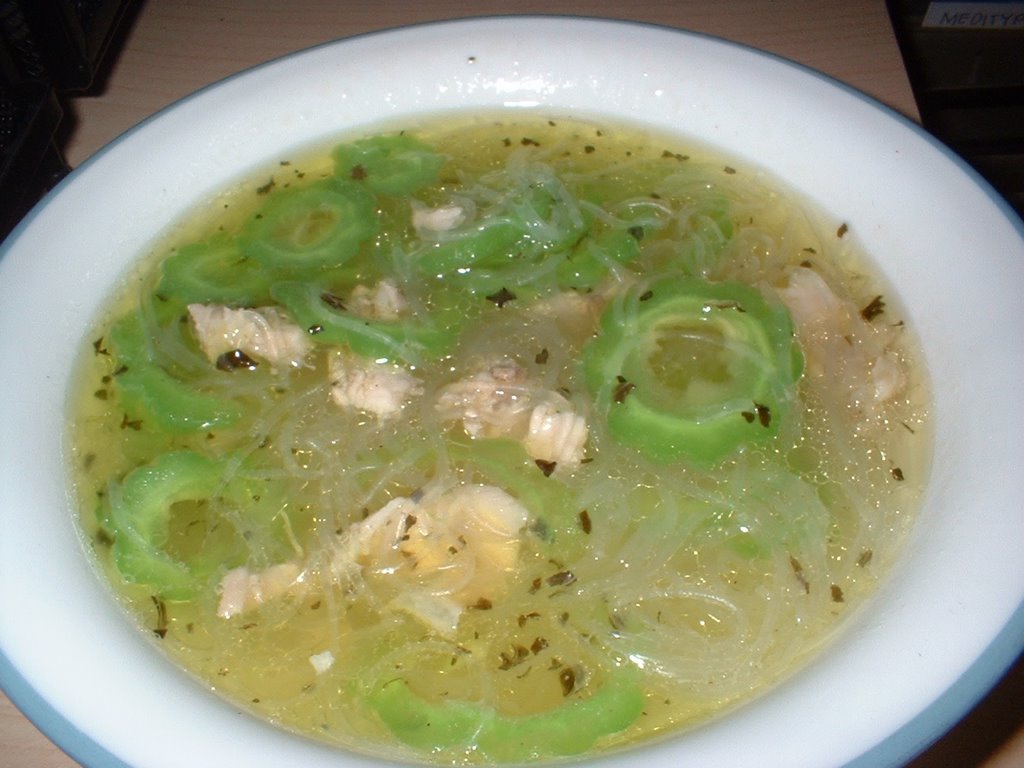
Another comfort food for me is the chicken sotanghon soup with thin slices of bittermelon. It is a "manang" thing. I don't know of anyone else who likes this, but I do remember this as being introduced to my by my Nanay (just like I love tinolang manok with ampalaya and sweet corn that she also introduced to us, I like this sotanghon soup with ampalaya). As usual, I just need chicken stock and meat for this, basically. I soak the sotanghon noodles first in hot water for about 5 minutes while I reheat the stock with meat. I seldom have ampalaya, so this is something I make only when I have these ingredients. And I am the only one who likes it in this family. My sons have not developed the taste for ampalaya (they tried, but did not like it). I let the ampalaya slices sit with salt sprinkled on them for about 5 minutes then rinse with cold water and pressed to remove the bitter juices. Then when sotanghon is almost cooked I add the ampalaya and let cook for about a minute or two, sprinkle with ground basil, and enjoy my bowl of soup.
Although hubby is not too welcoming of any dish with thin soups (except New England Boiled Dinner, but he leaves the soup out), I and my boys still crave them, and this sinigang is one of the favorites. Of course, sinigang can make use of pork, shrimps, or fish. I have not tried sinigang na manok, although I love sinampalukang manok (I just don't have access to the tamarind leaves).
So, for my boys who love this dish, it is very simple and easy to make as long as you have sinigang mix, whether Mama Sita's or Knorr. Ingredients: 1 lb pork cuts (some fat is desirable) 2 bay leaves 3 cloves garlic 10 peppercorns 3 big tomatoes, cut in half 1 big onion, cut in half salt water to cover meat and veggies 1 eggplant, cut in wedges handful of okra (optional) 1 icicle radish, sliced across thinly (about 1/4 cm) 2-3 pcs taro or gabi (optional) handful of green beans (sitao if you have) sinigang mix 1/2 of cabbage
Procedure: Boil pork with bay leaves, garlic, peppercorns, onions and tomatoes, with 1 tbsp salt for about 30 minutes. Add the veggies except cabbage and cook another 5 minutes. Add sinigang mix and some more salt to taste. Add cabbage and cook another 2 minutes or so. Eat with plain rice.
(and when you have had sliced fresh cukes and corn for like a week already, you get tired of having them again and again).
So, I was going to cook this tinola, and was thinking, "I wish I had sayote or papaya." The papaya I could buy from hannaford here was too yellow/ripe for the purpose (I ended up eating that uncooked - manibalang was better for eating than the fully ripe, in my opinion). I combined with corn and bell pepper leaves from our garden (I chose only the youngest good-sized leaves; the more mature leaves are too strong). I was not disappointed with the result. My sons and I loved it.
Of course, the real main ingredients for tinola (aside from chicken meat) are: green papaya/malunggay or chayote (sayote)/dahon ng sili (fresh pepper leaves)
I cooked the breasts, thighs and legs separately as adobo. I made this for the soup and veggies.
My final ingredients for this dish: Chicken, cut up into serving pieces 2 tbsp oil (or you can use the skin to render oil) 2 cloves garlic, crushed thumb-size ginger, sliced water enough to cover meat and veggies 1-2 cukes, cut in chunks 1 cup sweet corn kernel 1-2 handfuls of pepper greens salt and pepper to taste
On medium high heat, sautee garlic and ginger until browned and fragrant. Add chicken pieces and sautee until browned. Sprinkle some salt, cover and lower heat to cook for 10 minutes. Take cover off, add water and turn on high to boil. Add cukes and corn and cook for another 5 minutes or until chicken is done. Turn off heat and stir in pepper greens until wilted.
and I think the best part to use for this dish is what we Filipinos refer to as kenchi (our freezer stock is labeled "soup bone" but the actual cut is from the shanks. The Mama Sita's ready mix has the "oxtail" on the procedure. Well, it is good for the flavor, but shank meat is best for eating enjoyment of this Pinoy dish. When I do want this dish, I usually make bulalo with more meat and soup than we could use, so that I will have leftover boiled meat for kare-kare. And I do not put salt to achieve the right saltiness because kare-kare is meant to be not salty, so we can enjoy it with bagoong alamang (shrimp paste). This is how I prepare it. Prepare in a slow cooker the following: oxtail, soup bones (Boil first in plain water for 10-15 minutes, removing scum as it rises, then dish these out and place in slow cooker) water, enough to cover the meat/bones and some more 3-5 cloves garlic 10-15 peppercorns 5 bay leaves some salt
Slow cook for 8 hours on low setting.
Set aside 3 cups of broth. Boil the vegetables (typically chunks of eggplant which go first followed by green beans.
When eggplant and green beans are done, add the mixture and stir to mix well until thickened to desired consistency. Add bok choy and cook for about 1-2 minutes.
Serve over hot rice with shrimp paste.
My younger son and I love it. My older son, so-so. My husband, forget it. He never did like any meat part with lots of fascia/ligaments in it, tender or not.