Showing posts with label jam n jellies. Show all posts

Wednesday, September 02, 2009

Mango Jam


It is my first time to make these mango jams. Although I typically use fresh produce when making jams and jellies (and when canning, generally), I don't have a choice with mangoes. The advantage is that mangoes here are available all year round, coming from Mexico. So I can make these jams whenever. My kids love it so much, they seem to prefer the jam over the plain fruit. I think this would also go well in crepes.

Ingredients:
4 cups finely chopped ripe mangoes (I used the red mangoes variety; tastes like ripe Indian Mangoes; I had no other choice here)
2 tbsp fresh lemon juice
5-1/2 cups sugar
1 packet of sure-jell (there are two in each box)

Instructions:

1. Wash lids and jars in hot water; keep the jars filled with hot water until you are ready to put them in boiling water so they do not get shocked with temperature change (which might cause cracks). Start boiling water in a large pot for sterilizing. Place each jar in boiling water for at least 5 minutes before using (maybe 3-4 jars at a time).
2. Prepare fruit as above. Measure exact amount into a 6- or 8-qt saucepot (mixture might boil over if you use a smaller pot). Stir in lemon juice.
3. Measure exact amount of sugar into separate bowl.
4. Stir in 1 packet (the original direction says 1 box, but I think I got the right consistency with just 1 packet. 1 box contains 2 packets.)
5. Bring mixture to full rolling boil (a boil that does not stop bubbling when stirred) on high heat, stirring constantly.
6. Stir in sugar quickly. Return to full rolling boil and boil exactly 1 minute, stirring constantly.
7. Ladle quickly into prepared jars, filling to within 1/8 inch of tops. Wipe jar rims and threads. Cover with two-piece lids dipped quickly in boiling water (don't boil the lids - will damage the rubbery seal). Screw bands tightly. Place jars upside down on countertop for about 5 minutes before setting them upright. Do this step repeatedly with each jar, and replace each jar whenever you take one out from the sterilizing pot, remembering to take the first one out for ladling jam.) If you have a jar that is not full, you may use unsterile cover, but place this in the fridge and consume this first.

Monday, February 23, 2009

Strawberry Jam

I am at work right now...I needed something to keep me awake...coffee...still sleepy.

Blogging...sure way to keep my mind going...so here I am.

I was reviewing my old posts from my old kusina that I transferred here. Most of the posts then had recipes on geocities webpage that I tied up with my blog posts because photoblogging then was not yet "in" at the time. I (painstakingly) made separate webpages to show step-by-step photos of things I was doing then. I was quite surprised to find out I did make one for homemade strawberry jam, but which was not tied to a blog post. So I am making one for that now. Though strawberry season is quite far away...

I make strawberry jams whenever my MIL tells me she has had enough for her own use. My kids would pick them, we would eat some, and the rest I would make into strawberry jams. Strawberry jams and raspberry jams are our favorites. Very good on rolls, Club crackers, over cheesecake, etc. I have brought several jars of these for munchin during work, and my British and American co-workers loved my homemade jams. "Cannot compare with them commercial ones!"

Ingredients:

5 1/2 cups mashed strawberries
1 box pectin (Her preference is Sure-Jell)
7 cups sugar
8 jars for canning

Instructions:

Boil water for sterilizing jars then let simmer until ready for sterilizing jars. Wash jars and screw bands in hot, soapy water; rinse with warm water.

Prepare strawberries by removing the stems and mashing thoroughly with fork. (I think you can also use chopper batch by batch.) Put in a big saucepan and heat to boil, constantly stirring while gradually adding the pectin until fully dissolved and bring to full rolling boil (A boil that does not stop bubbling when stirred) on high heat, stirring constantly.Add 1/2 tsp butter or margarine to reduce foaming, if desired.

Stir in sugar quickly. Return to full rolling boil and boil EXACTLY 1 MINUTE, stirring constantly. Remove from heat.

Skim off any foam with metal spoon.

Pour quickly into prepared jars, filling to within 1/8 inch of tops. Wipe jar rims and threads.

Cover with two-piece lids. Screw bands TIGHTLY.Turn upside-down right away, then turn upright again after 5 minutes (This process is to ensure that minimal (unsterile) air is trapped, and that the hot jam will sterilize that space by inversion. Setting it upright after 5 minutes will ensure proper setting where the jam does not stick to the lid.)

Let stand at room temperature 24 hours. You may store unopened jams in cool, dry dark place up to 1 year. Refrigerate opened jams up to 3 weeks.

You may use strawberry jams on rolls/bread, Ritz crackers or saltine crackers.

Note: Upon setting, if you are using a larger jar, you may notice separation of layers. Above is the jam with all the bits of strawberries, and below a clear layer, which is the jelly.

Also, after the strawberry season comes the raspberry. When picking, the stems easily detach from the ripe fruits. Wash the raspberries just before the procedure, then proceed as with the strawberry jam procedure.


Tips:

Freshly picked strawberries should be washed ONLY when you are ready to consume/use it, otherwise it will spoil easily.

Pick only red and plump strawberries. When picked too soon, it won't have a sweet taste.

When in full rolling boil, you may lessen the foaming by adding 1/2 tsp butter.

Follow closely the timing of pouring boiling water into the jars and of removing the water and of closing the jars with the lids. Also minimize the air incorporated in the jar. Leaving a small space for air will result in popping in of the lid when the jam cools down, a sign of successful technique to ensure sterile procedures.

Additional info on jams and jellies available at www.surejell.com .


Friday, January 16, 2009

Concord Grape Jelly

This is a re-posting from my Old Kusina. I am posting with today's date mainly for A Scientist in the Kitchen, who expressed interest in learning more about making jams and jellies. Maybe those in the Philippines can also experiment using our very own fruits. I have seen my ex-MIL make guava jelly even without pectin, so probably we can also find out how to make jams and jellies out of those fruits without using pectin.

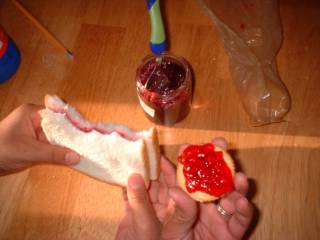
Children like it on sandwiches, I like it on Ritz or saltine crackers, hubby likes it (and raspberry and strawberry jams) with peanut butter for sandwiches. It is quite a bit sour for my taste, but my hubby and in-laws like the contrast of sweetness and tartness (maybe because they are used to these sour berries and grapes). One thing for certain, these home-made jams and jellies are far superior than the commercial ones.

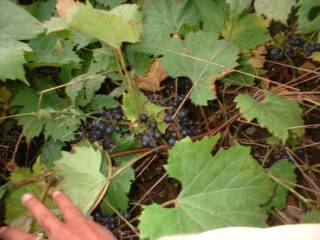
These are concord grapes, and they are very very tart! Not at all suitable for eating in its raw form. I had about 2 pounds or more of these bunches about a week before the first frost hit us. Then I waited for the second batch, which I made the morning right after the first frost (a friend's mother-in-law told me they taste better after frost).


1 big colander is equivalent to more than a pound of them, but I had to wash, remove the green ones (choose only the most purple ones) to make into grape jelly.

Ingredients:

5 cups prepared juice (about 3-1/2 lb. fully ripe Concord or you may use other loose-skinned grapes)
1-1/2 cups water
1 box Fruit Pectin (Sure-Jell or Ball Brand)
1/2 tsp. butter or margarine (optional)
7 cups sugar, measured into separate bowl

Preparing the juice:

STEM and crush grapes thoroughly, one layer at a time. Place in large saucepan; add water.


Bring to boil. Reduce heat to low; cover and simmer 10 minutes, stirring occasionally.

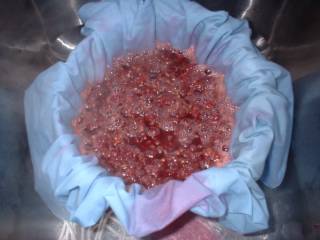
Place 3 layers of damp cheesecloth or jelly bag in large bowl. (I had none at the time. I improvised using a clean old pillowcase with a small cheesecloth sandwiched inside.) Pour prepared fruit into cheesecloth.


Tie cheesecloth closed; hang and let drip into bowl until dripping stops. Press gently (If you squeeze hard, you might end up with turbid jelly). Measure exactly 5 cups prepared juice into 6- or 8-quart saucepot.

(I did this juice preparation at night and let it drip overnight. Then I proceeded with the next step the next morning)

Making the jelly:

BRING boiling-water canner, half full with water, to simmer. Wash jars and screw bands in hot soapy water; rinse with warm water. Pour boiling water over flat lids in saucepan off the heat. Let stand in hot water until ready to use. Drain well before filling.


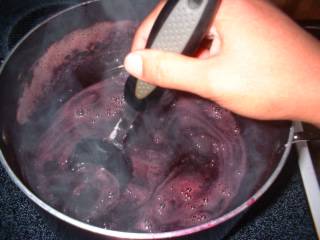
STIR pectin into juice in saucepot. Add butter to reduce foaming, if desired. Bring mixture to full rolling boil (a boil that doesn't stop bubbling when stirred) on high heat, stirring constantly.

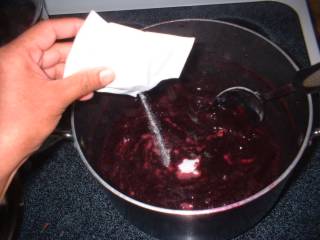
Stir in sugar all at once and keep on stirring until dissolved.


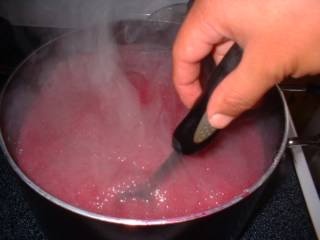
Return to full rolling boil and boil exactly 1 minute (set the timer!), stirring constantly. This is how a full rolling boil looks like, where any stirring won't keep the bubbles down (hence, if the pot is not big enough, it might overflow). After one minute, remove from heat.


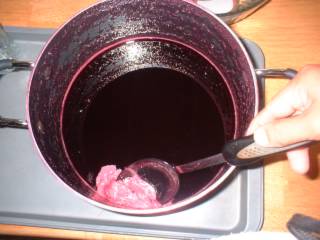
Skim off any foam with spoon.

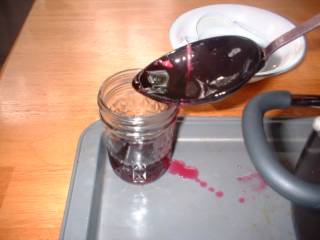
Ladle into the hot jars.


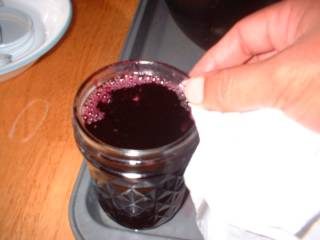
Wipe with damp paper towel the sealing surfaces.

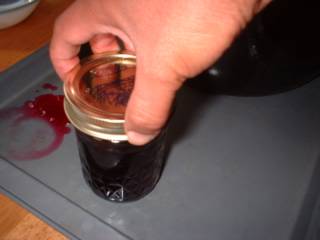
Pick the lid and screw band submerged in boiling water using the magnetic picker, then cover the jars and close, fingertip-tight.


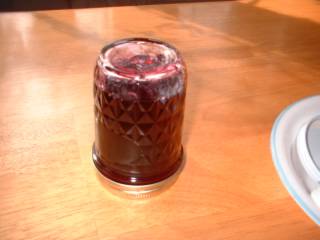
Turn upside down for 5 minutes then turn upright again (this is when you want to eliminate processing in boiling-water canner for 5 minutes).

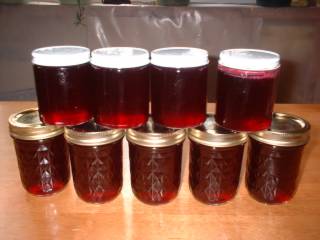
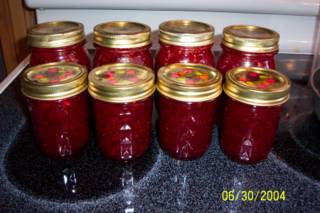
Set them on a place without disturbing for at least 12 hours. Then watch out for covers that did not pop in (downward concavity). If there's one, or if a jar is not full like in the upper small jar in this phot, place in the fridge and consume immediately, preferably within 2 weeks.


I also make strawberry jams , blueberry jams, and raspberry jams (which are made almost in the same manner; the only difference being in the proportions). Our family's fave is the raspberry jam, and when I did bring one to work, to go with some Club crackers, everyone loved it. The nurse travelers (a couple) who were based in Florida even expressed how superior it was over commercially prepared ones. Maybe those in the Philippines can try to make jams out of aratiles or other lowly berries we have, and adjust the amount of sugar according to how sour or sweet they are....just a suggestion for those who are thinking of going into the food business for something less paid attention to, so competition is less. This process is almost a no-brainer and will require very little capital.

(To my Filipina readers/friends in the Philippines who might be interested in making home-made preserves, a web research lead me to this site which gives the telephone number for the pectin producer in the Philippines and globally.) [That link is not valid anymore!] I know that pectin is available in the Philippines because when I was still in college (BS Biology), two of my classmates worked on a thesis involving pectin. At the time I only knew that it was a gelling agent and knew nothing about it. Apparently it can be extracted (as hesperidin?) from citrus peels, also from apples. I do wonder what fruits will not need pectin to jell, given the proper proportion of fruits to water to sugar? These are the only ingredients to making jams and jellies, aside from pectin. Guava naturally has pectin as well.

Friday, December 01, 2006

Blueberries

Every year I get about 1 gallon of freshly picked blueberries from my MIL's garden.

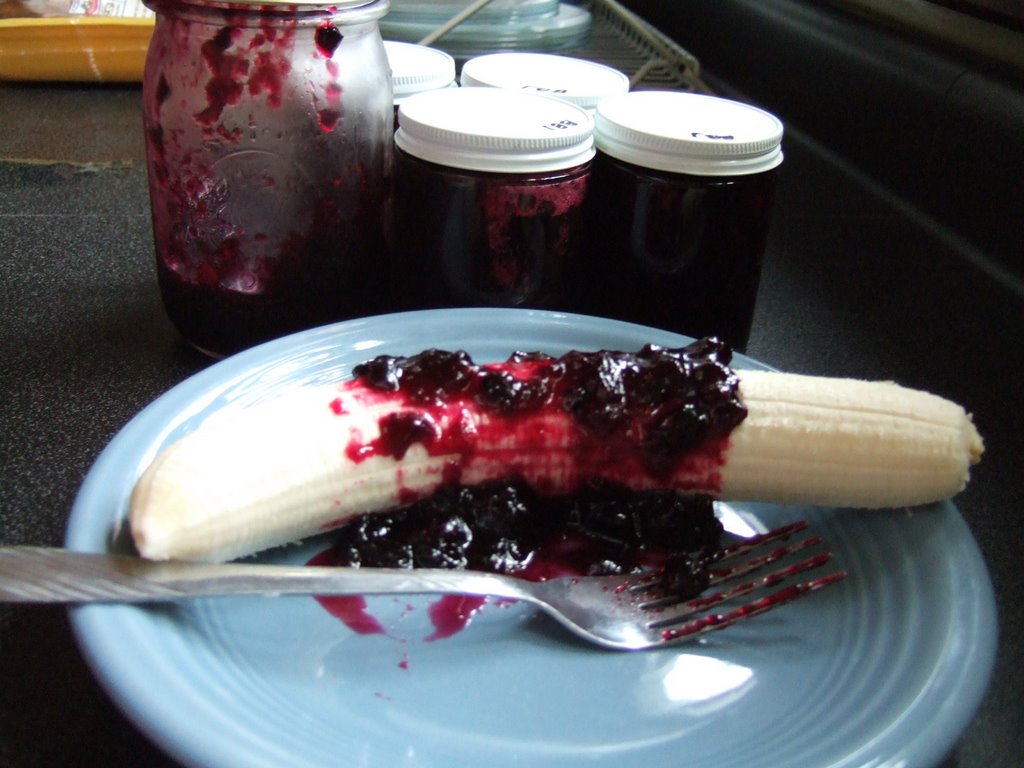
I make blueberry jam (recipe here), which I store in 3/4 cup jars, and which I love using on bananas, or saltine crackers, or toast...

I also use one such jar for the very tastyStonewall Kitchen's blueberry sourcream coffee cake, the recipe for which is as follows:

Ingredients
2 cups granulated sugar
2 cups all purpose flour
1 Tbsp vanilla extract
1 Tbsp baking powder
1/4 Tsp salt
2 sticks (1 cup) unsalted butter
2 eggs, beaten lightly
1 cup sour cream
1 - 13 oz. jar Stonewall Kitchen Wild Maine Blueberry Jam, stirred well

Directions
Pre-heat oven to 350 degrees.
Butter a 10” bundt pan and lightly dust the inside with flour.
In a mixer, or by hand, cream sugar and butter until light and fluffy.
Add eggs, blending well, and then add sour cream. Mix until combined.
Gradually fold in flour, vanilla, baking powder, and salt into creamed mixture until just blended.
Reserve 1/2 cup of batter and mix with 3/4 of the jar of blueberry jam.
Pour 3/4 remaining batter into the prepared pan, smoothing to the edges and creating a slight "trough" with a spatula.
Gently spoon the blueberry mix into the batter "trough", being careful not to touch the side of the pan.
Pour the remaining batter over the jam and smooth the top.
Set pan on middle rack in the oven and bake for about 60 minutes, or until the sides of the cake pull away from the pan and a cake tester (or toothpick) inserted in the center comes out clean.
Cool on a wire rack for at least 30 minutes. Turn onto a plate, sprinkle with confectioners sugar, drizzle with remaining jam and enjoy!

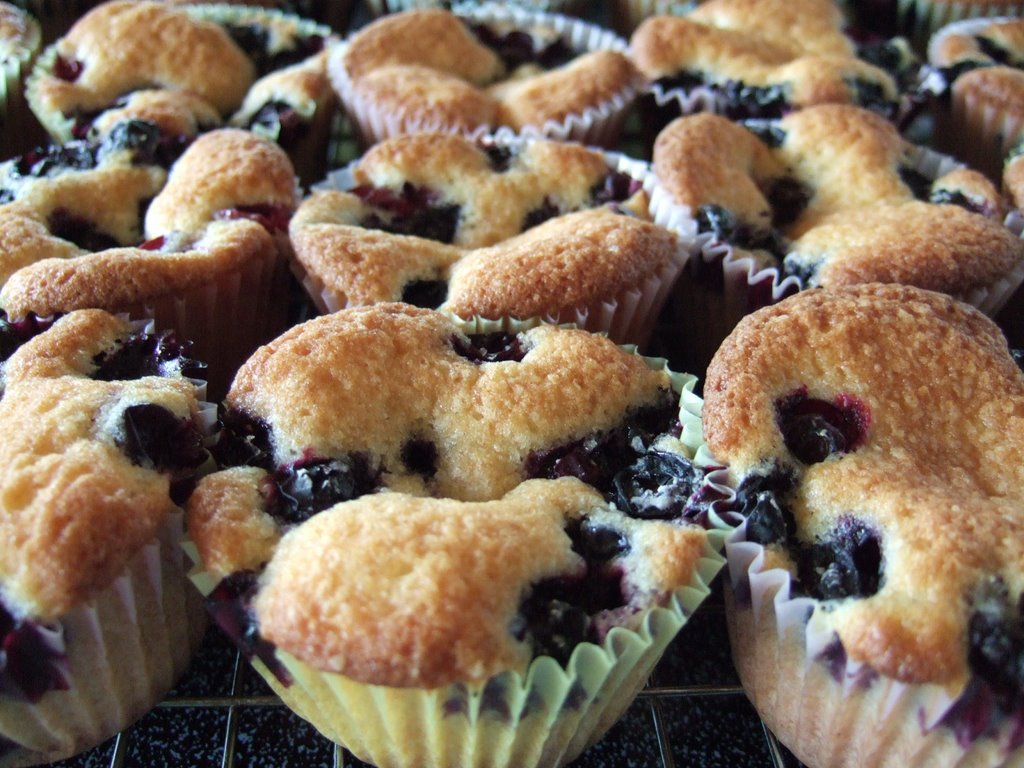
I also usually make these blueberry muffins, and though my favorite recipe for that so far does not produce the dome that I would like to have, it does come up with muffins which I like so much, and get better and better on the 2nd, 3rd, and 4th days.

Monday, July 05, 2004

Strawberries

It has dawned on me how people who live in areas where the summers are short and winters long have mastered the methods of food processing and preserving...from berries (which would have been of little value to Pinoys if they were native berries and grew wild, eaten all through the year for free...) to meats. Come to think of it...how many rotten tomatoes and veggies are being thrown away daily in the Philippines?...I have learned to take advantage of the growing season here...and I have learned to make jams and jellies among other things to preserve the produce that I got from my garden.

These are strawberries from Mom, freshly-picked from her garden.


I and the kids particularly liked the fresh strawberries mushed (in the chopper) and mixed with fresh cow's milk plus sugar...better than strawberry smoothie...

Posted by Hello
And because harvesting is done every 4 days or so, and Mom has 100 strawberry plants in her garden, the buckets we received either had to be eaten right away, or made into JAM...


Sweet and nutritious, strawberries are the first berries of the year. When picking, look for bright-red ones with fresh green leaves. Refrigerate 2 to 3 days, loosely covered. When ready to eat them, give a gentle rinse. Washing or slicing in advance will encourage spoiling.

Some tips from http://www.mycustompack.com/healthnotes/Food_Guide/Strawberries.htm#Nutrition-Highlights%20:
Strawberries freeze well. You can do so with or without sugar. To freeze strawberries using sugar, mix equal amounts of sugar and water in a saucepan. Stir over medium heat until sugar is dissolved and mixture is clear. Cool the mixture completely. Measure 1 cup (149g) of stemmed and sliced strawberries into a 2-cup-size (473.16ml) freezer bag. Pour 1/2 to 2/3 of a cup (118.3,157.7ml) of the sugar/water mixture into the bag,just enough to completely cover the strawberries. Seal and freeze the bag, keeping berries in a single layer.

To freeze strawberries without the use of sugar, set whole, firm berries on a cookie sheet, in a single layer and not touching each other, and place in the freezer. After berries are frozen, put them in a sealable plastic bag. This way they are 'individually frozen' and do not stick together.

Because the moisture content of strawberries varies throughout the season, it is recommended that home-frozen strawberries be used in beverages and sauces, not in recipes where liquid variations could make a difference. (Commercially frozen strawberries are consistent in texture and density.)

Thawing strawberries in the refrigerator will allow them to retain their shape better. When thawing at room temperature, keep the berries in a clean, sanitary environment. Cover and refrigerate unused thawed berries within two hours. Never try to speed up the thawing process by running water over the outside of the container, as that allows bacteria to grow. After thawing, keep berries refrigerated and use within three days. Never re-freeze strawberries.

While still attractive, thawed strawberries may be a little darker and lack the sheen that a fresh berry would have.
We consume about 1 small jar in 2-3 days, on Ritz crackers, or PB&J sandwiches, on pancakes, on muffins, and anything that suits us! Hope you too will enjoy your strawberries!

I also made jelly out of concord grapes.
Custom Search